
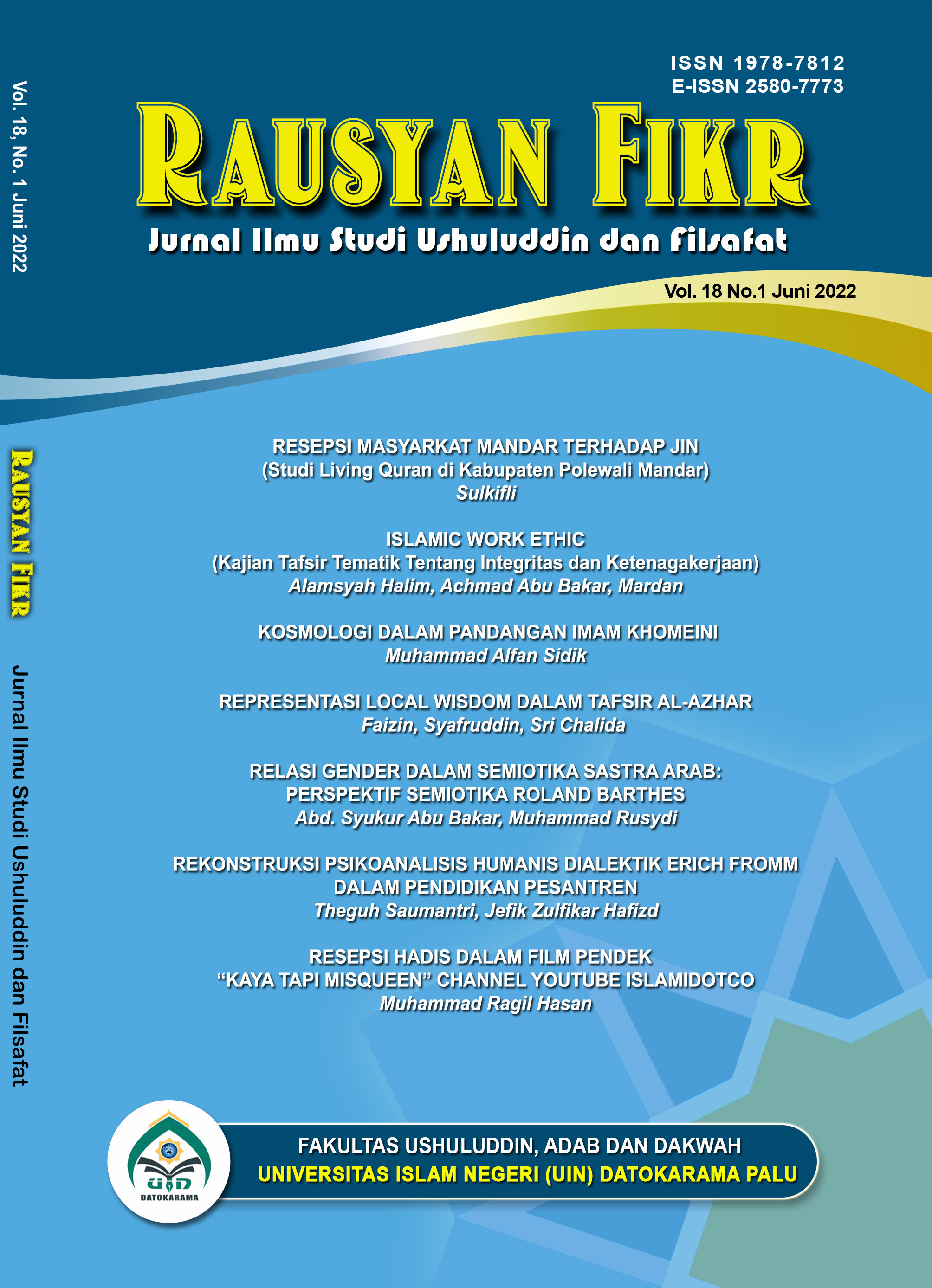
REPRESENTASI LOCAL WISDOM DALAM TAFSIR AL-AZHAR
Abstract
This paper analyzes the representation of local wisdom of Minangkabau culture in Buya Hamka's Tafsir al-Azhar, especially in interpreting verses about oral care. Tafsir al-Azhar is a work heavily influenced by the objective reality of local wisdom and the subjective side of the author as part of Minangkabau society. This research is literature research with content analysis through Stuart Hall's representation theory. This research shows that Hamka, in the interpretation of al-Azhar, especially the verses on oral protection, represents local wisdom: reflectively, intentionally, and constructionally. Reflectively, which directly explains the meaning of the verse he is interpreting. Consciously, Hamka interprets the verse as influenced by the collective consciousness of the Minangkabau community. Meanwhile, as a constructionist, Hamka deliberately constructs Minangkabau local wisdom in practicing interpreted verses.
References
Ahyar, Dasep Bayu. “Analisis Teks Dalam Penelitian Kebahasaan (Sebuah Teori Dan Aplikatif).” Shaut Al Arabiyyah 7, no. 2 (2019): 100. https://doi.org/10.24252/saa.v7i2.10273.
Amrullah, Haji Abdulmalik Abdulkarim. Tafsir Al-Azhar. Singapura: Pustaka Nasional PTE LTD, 1990.
Annisa, Dona Fitri, and Ifdil Ifdil. “Konsep Kecemasan (Anxiety) Pada Lanjut Usia (Lansia).” Konselor, 2016. https://doi.org/10.24036/02016526480-0-00.
Anwar, Husnel, Mhd. Roihan Nasution, and Muhammad Doli Zamzami Siregar. “Local Wisdom and Cultural Values in Al-Azhar Tafsir.” Studia Sosia Religia 3, no. 1 (2020): 29–50. https://doi.org/10.51900/ssr.v3i1.7669.
al-Baghawiy, Al-Husain bin Masúd. Ma’alim Al-Tanzil Riyad: Dar Al-Taybah, 1409. Riyadh: Dar al-Tayban, 1409.
Fiske, Susan, and Shelley Taylor. Sosial Cognition From Brains to Culture. 2nd ed. London: Sage Publication, 2013.
Hakim, Lukmanul. “Budaya Tutur Dalam Tafsir Melayu (Studi Wacana Peribahasa Melayu Dalam Tafsir Al-Azhar Karya Hamka).” Intizar 24, no. 1 (2018): 19–36. https://doi.org/10.19109/intizar.v24i1.1968.
Halimatussa’diyah, Halimatussa’diyah, and Apriyanti Apriyanti. “Sosio-Kultural Tafsir Al-Qur’an Melayu Nusantara : Kajian Atas Tafsir Al-Azhar Karya Hamka.” Jurnal Ilmu Agama: Mengkaji Doktrin, Pemikiran, Dan Fenomena Agama 19, no. 2 (2018): 222–34. https://doi.org/10.19109/jia.v19i2.2916.
Hall, Stuart. “Representation: Cultural Representations and Signifying Practices Spectacle of the Other.” Sage Publication, 1967, 400.
Ibn‘Asyur, Muhammad Tahir. ". Tafsir Al-Tahrir Wa Al-Tanwir. Tunisia: Darul Jamahiriyyah, 1984.
Ilyas, Abraham. Nan Empat: Dialektika, Logika, Sistematika Alam Terkembang. Sumbar: Lembaga Kekerabatan Datuk Soda, 2015.
Khadziq. Islam Dan Budaya Lokal: Belajar Memahami Realitas Agama Dalam Masyarakat. Yogyakarta: Teras, 2009.
Kusnadi. “Pantun Melayu: Kajian Terhadap Pesan Dakwah Dalam Tafsir Al-Azhar.” Wardah : Jurnal Dakwah Dan Kemasyarakatan 17, no. 2 (2016): 155–73.
M. Zia Al-Ayyubi, “Dinamika Tafsir Al-Qur’an di Indonesia”, Rausyan Fikr: Jurnal Ilmu Studi Ushuluddin dan Filsafat, Vol. 16 No. 1, 2020, 1 – 28.
Marrini, Liza, Harris Effendi Thahar, and Hamidin Hamidin. “Ungkapan Kiasan Minangkabau Di Desa Talawi Hilir Kecamatan Talawi Kota Sawahlunto.” MARKAH Jurnal Pendidikan Bahasa Dan Sastra Indonesia 1, no. 1 (2012): 186–94.
Miller, Richard B. “On Making a Cultural Turn in Religious Ethics.” Journal of Religious Ethics 33, no. 3 (2005): 409–43. https://doi.org/10.1111/j.1467-9795.2005.00229.x.
Mujahidin, Anwar. “Hubungan Kebudayaan Tafsir Indonesia.” Nun 3, no. 1 (2017): 89–116.
Mujahidin, Anwar, and Hyung-Jun Kim. “The Implication of Local Wisdom in Tafsir Al-Azhar on Moderate Islamic Thought By Hamka.” El Haraqah 23, no. 2 (2021): 239–55. https://doi.org/10.18860/eh.v23i2.13414.
Navis, A. Alam Terkembang Jadi Guru: Adat Dan Kebudayaan. Jakarta: PT Pustaka Grafiti Pers, 1986.
Oktavianus, Oktavianus. “Hate Speech and Local Cultural Values in Indonesia.” Proceedings of the International Congress of Indonesian Linguistics Society (KIMLI 2021) 622, no. Kimli (2022): 151–55. https://doi.org/10.2991/assehr.k.211226.031.
Rasid, Yunus. “Transformasi Nilai-Nilai Budaya Lokal Sebagai Upaya Pembangunan Karakter Bangsa (Penelitian Studi Kasus Budaya Huyula Di Kota Gorontalo).” Jurnal Penelitian Pendidikan, 14, no. 1 (2013): 65–77.
Saloom, Gazi. “Hate Speech: Psychological Perspective,” no. January (2022).
Setiawan, Ali Arif, Christina Nur Wijayanti, and Widyantoro Yuliatmojo. “Moralitas Bermedia Sosial.” Jurnal Ilmu Komunikasi 3, no. 1 (2022): 9.
Shihab, M. Quraish. Tafsir Al-Mishbah: Pesan, Kesan Dan Keserasian Al-Quran. Jakarta: Lentera Hati, 2002.
Tamrin, “Kecerdasan Anak dalam Perspektif Alquran”, Rausyan Fikr: Jurnal Ilmu Studi Ushuluddin dan Filsafat, Vol. 14 No. 2, 2018, 335 – 358.
Utami, Winda Wana, and Darmaiza Darmaiza. “Hate Speech, Agama, Dan Kontestasi Politik Di Indonesia.” Indonesian Journal of Religion and Society 2, no. 2 (2020): 113–28. https://doi.org/10.36256/ijrs.v2i2.108.
al-Qurtubi, Abu Abdillah Muhammad Ibn Ahmad. Al-Jami’ Li Akhkam Al-Qur’an. Kairo: Dar al-Kutub al-Mishriuah, 1964.
Copyright
The author(s) retain full copyright of the published article without restrictions. This includes the right to share, distribute, and reproduce the article in any form, including depositing the published version in institutional repositories or other platforms.
The author(s) also retain full publishing rights and may enter into separate, additional contractual arrangements for the non-exclusive distribution of the journal’s published version, provided that the original publication in this journal is properly acknowledged.
The author(s) grant the journal the right of first publication, as well as the right to distribute the article in both electronic and print formats. The journal is also granted the right to create, store, and maintain electronic archival copies of the article.
License to Publish

Rausyan Fikr: Jurnal Ilmu Studi Ushuluddin dan Filsafat is an open-access journal and under the licence of Creative Commons Attribution–NonCommercial–Share Alike 4.0 (CC–BY–NC–SA), which allows journal users to use the article under the following conditions.
Under this license, users are permitted to:
- Share — copy and redistribute the material in any medium or format.
- Adapt — remix, transform, and build upon the material.
Under the following terms:
- Attribution — Appropriate credit must be given to the author(s) and the original source, a link to the license must be provided, and any changes made must be indicated. This must be done in a reasonable manner without suggesting endorsement by the author(s) or the journal.
- NonCommercial — The material may not be used for commercial purposes.
- ShareAlike — If the material is remixed, transformed, or built upon, the resulting work must be distributed under the same license as the original.
No additional restrictions may be applied that would legally limit others from doing anything the license permits.



_(1)1.png)
















 This work is licensed under a