
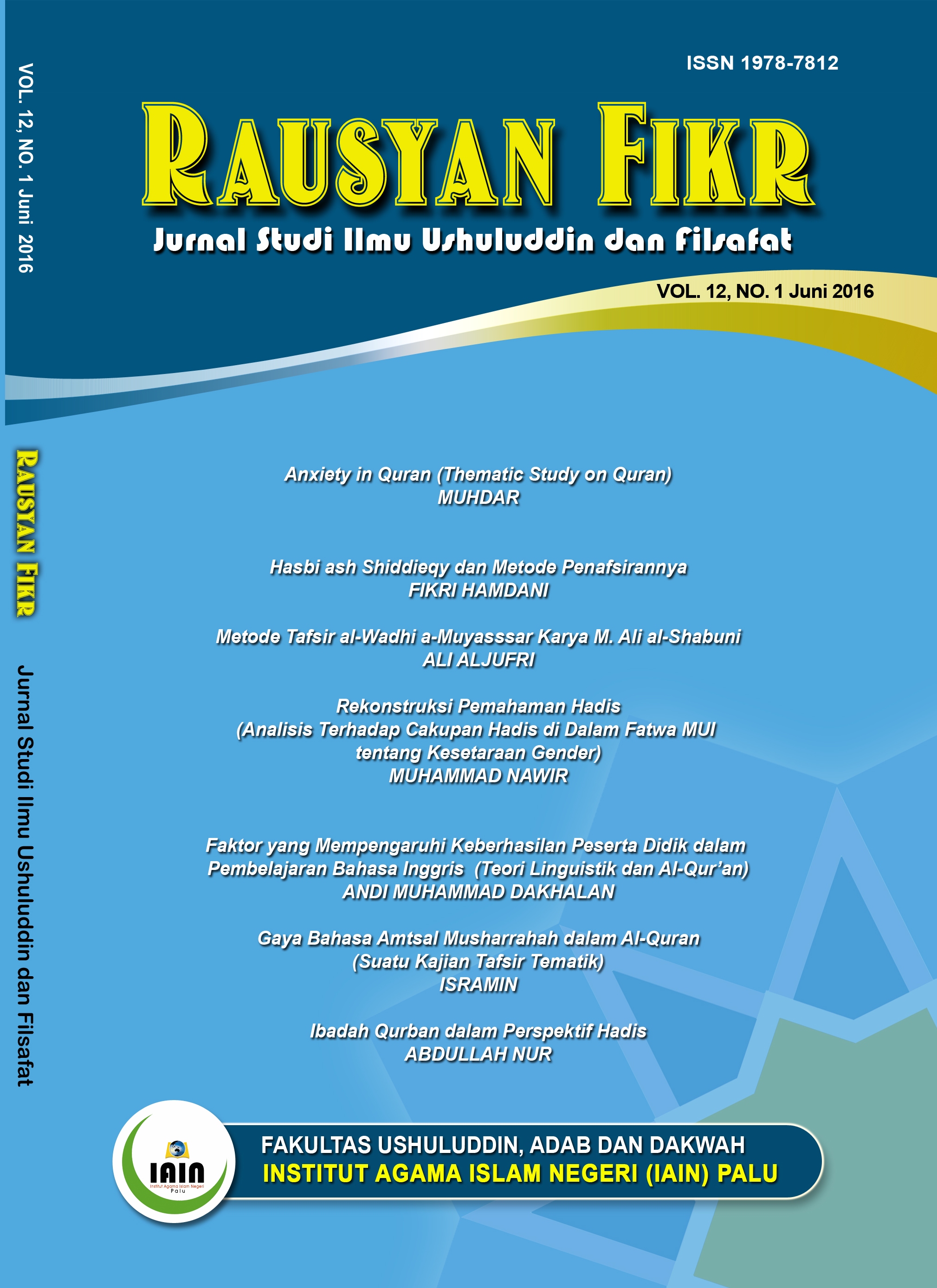
REKONSTRUKSI PEMAHAMAN HADIS
(Analisis terhadap Cakupan Hadis dalam Fatwa MUI tentang Kesetaraan Gender)
Abstract
The study concluded that the hadiths about gender equality in the fatwas of the Indonesian Ulama Council (MUI) was based on the validity of the arguments hadith, such as the rules of a tradition validity , which has been tested and recognized by the Hadith scholar of classical and authoritative. This study agrees with Ibnuddin (2011) which states that the MUI in the case of interfaith marriage less open to the socio cultural and socio real political currently there in the country, resulting in a controversial fatwa. M. Quraish Shihab (2003), Yusuf al-Qaradawi (2011), which explains that to understand the traditions of the creation of women, needs to be understood metaphorically. This study differs from Asrorun Ni'am Salah M. (2012) which states that the MUI fatwa on female circumcision is neutral between the two groups. The first group stated to perform the practice of circumcision in excess and the second group who forced himself to prohibition against female circumcision absolutely. Yunahar Ilyas (1997) study which states that the hadith about the creation of woman from the rib is a sound hadith that already valid either in text or contextmeaning. This study uses the Socio-historical approach. The primary data is a collection of MUI fatwa on gender equality issues, among them the fatwa of the imam pray for women, female circumcision, interfaith marriage, female leader. While secondary sources are books of hadith, hadith and sirah Sharh al-Nabawiyah especially that rested in the MUI issued fatwa
Copyright
The author(s) retain full copyright of the published article without restrictions. This includes the right to share, distribute, and reproduce the article in any form, including depositing the published version in institutional repositories or other platforms.
The author(s) also retain full publishing rights and may enter into separate, additional contractual arrangements for the non-exclusive distribution of the journal’s published version, provided that the original publication in this journal is properly acknowledged.
The author(s) grant the journal the right of first publication, as well as the right to distribute the article in both electronic and print formats. The journal is also granted the right to create, store, and maintain electronic archival copies of the article.
License to Publish

Rausyan Fikr: Jurnal Ilmu Studi Ushuluddin dan Filsafat is an open-access journal and under the licence of Creative Commons Attribution–NonCommercial–Share Alike 4.0 (CC–BY–NC–SA), which allows journal users to use the article under the following conditions.
Under this license, users are permitted to:
- Share — copy and redistribute the material in any medium or format.
- Adapt — remix, transform, and build upon the material.
Under the following terms:
- Attribution — Appropriate credit must be given to the author(s) and the original source, a link to the license must be provided, and any changes made must be indicated. This must be done in a reasonable manner without suggesting endorsement by the author(s) or the journal.
- NonCommercial — The material may not be used for commercial purposes.
- ShareAlike — If the material is remixed, transformed, or built upon, the resulting work must be distributed under the same license as the original.
No additional restrictions may be applied that would legally limit others from doing anything the license permits.



_(1)1.png)
















 This work is licensed under a