
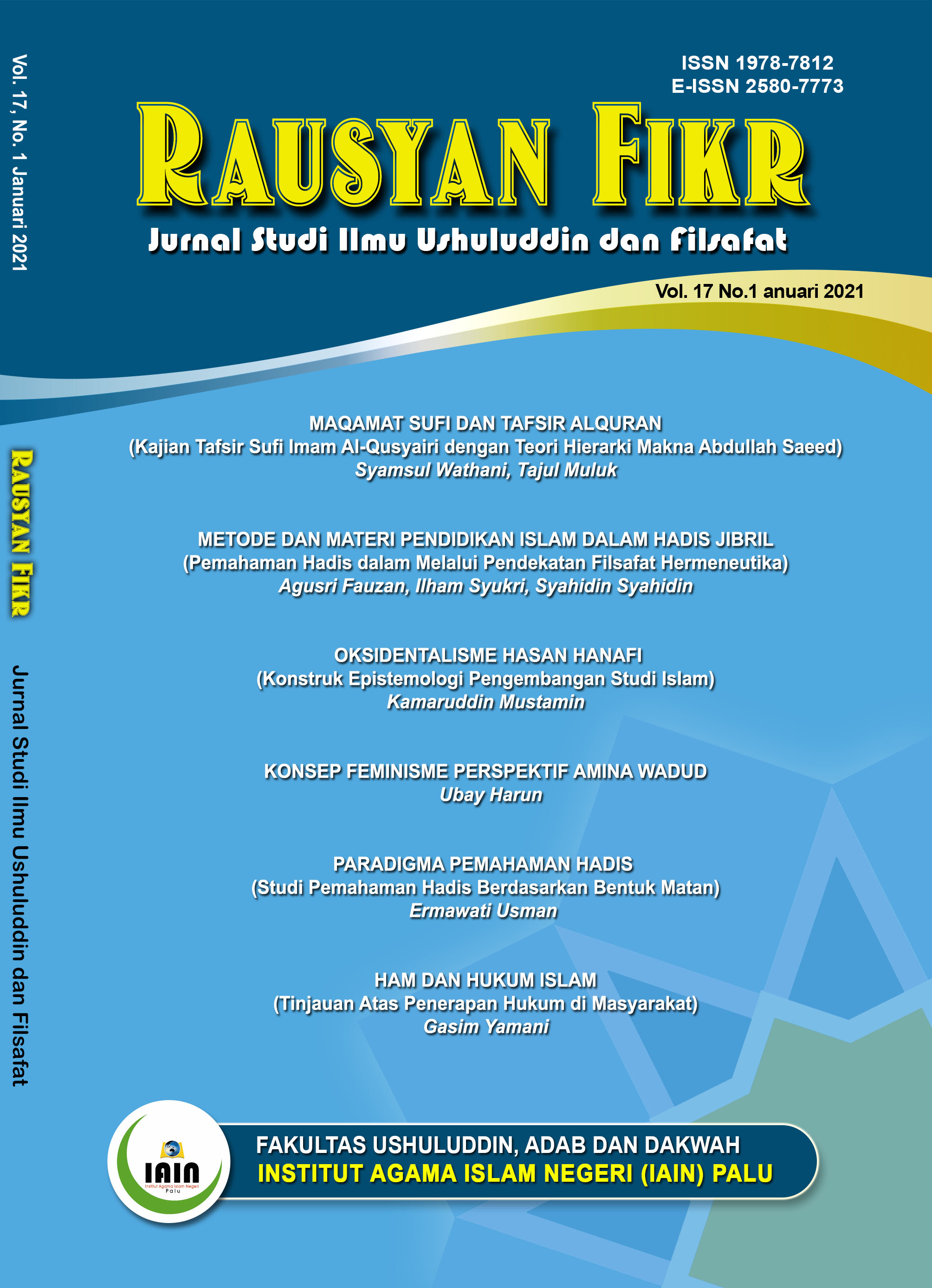
Paradigma Pemahaman Hadis
(Studi Pemahaman Hadis Berdasarkan Bentuk Matan)
Abstract
The scholars look for formulas and strategies to explain the meaning of hadith. Many methods, techniques and approaches are offered by hadith scientists to pave the way for understanding hadith so that hadith which is a product of the past can be kept up to date and become a guide for Muslims who are rahmatan lil alamin. To obtain a comprehensive understanding of the matan of hadith, one way is to have knowledge of the form of matan used by the Prophet Muhammad in the expression of hadith. The forms of hadith expressions referred to are Jawamil kalim, tamsil, ramzi, qiyas and conversational forms, which are the privileges of the Prophet Muhammad in conveying hadith. The five features are adapted to the case faced by the Prophet Muhammad, and cannot be focused on a particular hadith. Thus, the language of the Prophet's da'wah has a meaning value package in conveying parables and symbolic expressions for friends' questions. The expression in the form of matan, can be one of the tools in understanding hadith. This paper will describe the traditions that have the forms of matan which contain the five styles of language above, by presenting several examples that are elaborated on the thoughts or understandings of the hadith scholars.
References
Al-Adlabi, Salahuddin ibn ahmad, Manhaj Naqd al-matn Ind Ulama’ al Hadits al-Nabawi, alih bahasa H. M Qodirun Nur ahmad Musyafiq, Metodologi Kritik Matan Hadits. Cet. I; Jakarta: Gaya Media Pratama, 2004.
Ahmad, Arifuddin, Paradigma Baru Memahami Hadits Nabi, Refleksi Pemikiran Pembaruan Prof. Dr. Muhammad Syuhudi Ismail. Cet. I; Jakarta: Renaisan, 2005.
Ahmad, H. Muhammad, M. Mudzakir, Ulumul hadits. Cet. III; Bandung: CV. Pustaka Setia, 2004.
Amin, Kamaruddin, Menguji Kembali Keakuratan Metode Kritik Hadis, Cet. I, Jakarta: Penerbit Hikmah, 2009
Azami, MM, Studies in Hadith Methodology and Literature, (Indiana, Amerikan TrustPublication, 1992)
Ahmad al-Qastalani, Irsyad al-Sari Li Syarh Sahih{ al-Bukhari, jilid II (Beirut: Dar al-Fikr, 1990), 713.
Al-Bukhari al-Ja’fi, Abu Abdillah Muhammad Ibn Ibrahim bin al-Mughirah bin Bardzabah, Shahih Bukhari, Juz V. Beirut: Dar al-Kutub al-Ilmiyah, 1996.
Al-Asqalani, Ahmad bin Ali bin Hajar, Fathul Bari Juz 10, t.tp.: Al-Maktabah al-Salafiyah, t.th.
Departemen agama RI., Al-Qur’an dan Terjemahnya. Jakarta: PT. Syamil Cipta Media, 2005.
Al-Ghazali, Syaikh Muhammad, As-Sunnah An-Nabawiyyah: Baina ahl Fiqh wa Ahl al-Hadits, diterjemahkan oleh Muhammad Al-Baqir dengan judul Studi Kritis atas hadits Nabi Saw. Cet. VI; Bandung: Mizan, 1989.
Arifin, Muhammad Patri, “Obat Penawar dan Penyakit di Sayap Lalat (Integrasi-Interkonektif Hadis dengan Ilmu Pengetahuan)”, al-Munir: Jurnal Studi Ilmu al-Qur’an dan Tafsir, Vol. 2, No. 2 Juli 2020.
Muhammad Patri Arifin, “Karakteristik Dakwah Khulafa Al-Rasyidin”, Al-Misbah: Jurnal Ilmu Dakwah dan Komunikasi, Vol. 13 No. 1, 2017.
M. Syuhudi Ismail, Hadits Nabi menurut Pembela, Pengingkar dan Pemalsunya. Cet. I; Jakarta: Gema Insani Press, 1995.
--------, Hadits Nabi yang Tekstual dan Kontekstual, (Tela’ah Ma’ni al-Hadits tentang Ajaran Islam yang Universal, Temporal dan Lokal). Cet. I; Jakarta: PT. Bulan Bintang, 1994.
--------, Metodologi Penelitian Hadits Nabi. Cet. I; Jakarta: PT. Bulan Bintang, 1992. Al-Nawawi, Al-imami Muhyiddin, Syarah Shahih Muslim, Juz I. Beirut: dar al-Ma’rifah, 1996.
Iqbal, Muhammad, Recontruction of Religius Though in Islam, (New Delhi: Kitab Bhavan, 1981 M.
Nata, Abuddin, Metodologi Studi Islam, (Cet. II; Jakarta: PT. Rajagrafindo Persada, 2007)
Al-Qardhawi, Yusuf, Kaifa Nata’amalu ma’a al-Sunnah al-Nabawiyyah, diterjemahkan oleh Saifullah Kamalie Metode Memahami As-Sunnah dengan Benar. Jakarta: Media Da’wah, t.th.
Al-Qusyairi al-naisaury, Abu Husain Muslim bin Hujjaj Shahih Muslim, Juz III. Beirut: Dar al-kutub al-Ilmiyah, 1996.
--------, Al-Madhal li al-Dirasah al-Sunnah al-Nabawiyyah, alih bahasa, Agus Suyadi Raharusun, Pengantar Studi Hadits. Cet. II: Bandung: Pustaka Setia, 2007.
Poerwadarminta, W.J.S., Kamus Umum Bahasa Indonesia (Jakarta: Balai Pustaka, 1985)
Saman, Bustamin, M. Isa H.A., Metodologi Kritik Hadits, Cet. I; Jakarta: PT. Raja Grafindo Persada, 2004.
Zailani, Metode Intertekstual Memahami Hadis Nabi, (AL-Fikra: Jurnal Ilmiah Keislaman, Vol. 15, No. 2, Juli – Desember 2016)
Zakiar, Bahasa Tamsil Hadis dalam Kitab Riyadush shalihin: Kajian Bab Menjaga Sunnah-sunnah Nabi saw., Jurnal Islamika: Jurnal Ilmu-ilmu Keislaman, Vol. 18, No. 02, Desember 2018
Copyright
The author(s) retain full copyright of the published article without restrictions. This includes the right to share, distribute, and reproduce the article in any form, including depositing the published version in institutional repositories or other platforms.
The author(s) also retain full publishing rights and may enter into separate, additional contractual arrangements for the non-exclusive distribution of the journal’s published version, provided that the original publication in this journal is properly acknowledged.
The author(s) grant the journal the right of first publication, as well as the right to distribute the article in both electronic and print formats. The journal is also granted the right to create, store, and maintain electronic archival copies of the article.
License to Publish

Rausyan Fikr: Jurnal Ilmu Studi Ushuluddin dan Filsafat is an open-access journal and under the licence of Creative Commons Attribution–NonCommercial–Share Alike 4.0 (CC–BY–NC–SA), which allows journal users to use the article under the following conditions.
Under this license, users are permitted to:
- Share — copy and redistribute the material in any medium or format.
- Adapt — remix, transform, and build upon the material.
Under the following terms:
- Attribution — Appropriate credit must be given to the author(s) and the original source, a link to the license must be provided, and any changes made must be indicated. This must be done in a reasonable manner without suggesting endorsement by the author(s) or the journal.
- NonCommercial — The material may not be used for commercial purposes.
- ShareAlike — If the material is remixed, transformed, or built upon, the resulting work must be distributed under the same license as the original.
No additional restrictions may be applied that would legally limit others from doing anything the license permits.


_(1)1.png)
















 This work is licensed under a