
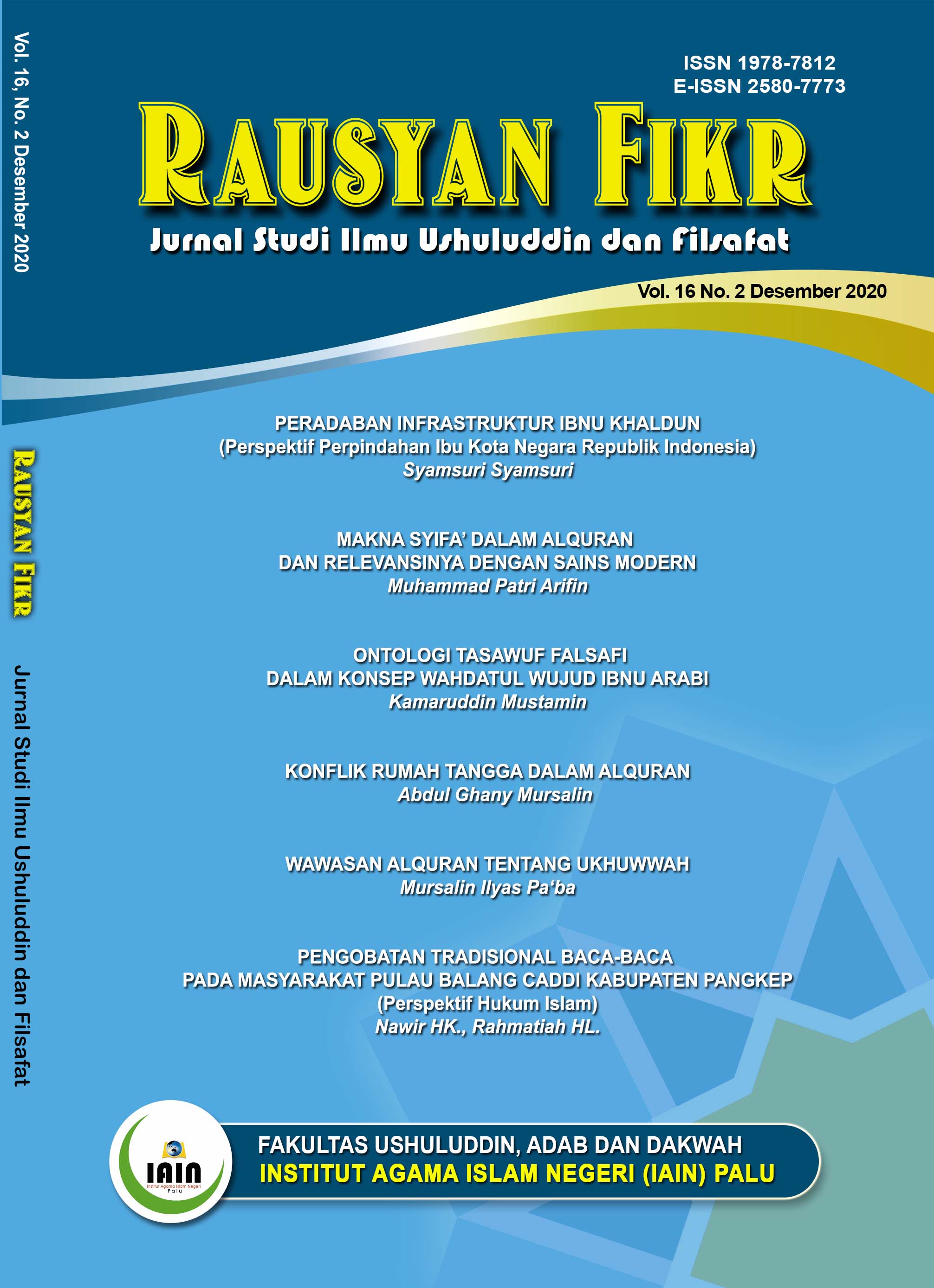
Ontologi Tasawuf Falsafi dalam Konsep Wahdatul Wujud Ibnu Arabi
Abstract
Ibn Arabi's wahdatul wujud concept, which has tended to be trapped in a static understanding of a unified existence between the Creator and the one created in the locus of pantheism must be understood as an active movement in which beings who are in the levels of selfhood must always strive to move actively towards the levels of reality. This has implications for the need to develop a more inclusive understanding in understanding metaphorical-sufistic language which seems foreign to ordinary people. The ontology of philosophical tasawuf in Ibn Arabi's wahdatul wujud concept has provided a methodological framework that emerged from the sitesis of two different scientific groups, namely Sufism with its esoteric dimension and philosophy with its philosophical dimension in uncovering the meaning of Ibn Arabi's wahdatul wujud concept.
References
Arsyad, Azhar dan Muhammad Sabri, Membangun Tradisi Hikmah dan Mengasah Inner Capacity: Ikhtiar Merancang Paradigma Keilmuan UIN Alauddin Makassar, Makassar: Alauddin Press, 2009.
Aziz, Abdul, Wahdatul Wujud Ibnu Arabi dalam Pandangan Toshihiko Izutsu, https://bincangsyariah.com/khazanah/wahdatul-wujud-ibnu-arabi-dalam-pandangan-toshihiko-izutsu. (4 Oktober 2020)
Bagir, Haidar, Epistemologi Tasawuf: Sebuah Pengantar, Bandung: Mizan, 2017.
Fadlullah, M. E., Ahlu al-Sunnah wa al-Jamaah dalam Perspektif Said Aqil Siradj, Nidhomul Haq: Jurnal Manajemen Pendidikan Islam Vol. 3 No. 1 Tahun 2018.
Fuadi, Muhammad, Memahami Tasawuf Ibnu Arabi dan Ibnu al Farid: Konsep al Hubb Illahi, Wahdat al Wujud, Wahdah al- Syuhud dan Wahdat al-Adyan, Ulul Albab: Jurnal Studi Islam Vol. 14 No. 2 Tahun 2013.
Husaini, Moulvi, Ibnu al-Arabi, Lahore: SHM Ashraf, 1977.
Magniz-Suseno, Frans, Menalar Tuhan, Yogyakarta; Kanisius, 2006
Maulana, Muh. Panji, Filsafat Ketuhanan Ibnu Arabi: Telaah Kitab Hill al-Rumuz wa Mafatih al-Kunuz, Jurnal Yaqzhan Vol. 4 No. 2 Tahun 2018.
Musa, M. Yusuf, Falsafah al-Akhlaq fi al-Islam, Kairo: Muassasah al-Khanji, 1963.
Noer, Kautsar Azhari, Ibn al-Arabi: Wahdah al-Wujud dalam Perdebatan, Jakarta: Paramadina, 1995.
Rosihon, A., Akhlak Tasawuf, Bandung: Pustaka Setia, 2010.
Schimmmell, Annemarie, Dimensi Mistik dalam Islam, Jakarta: Pustaka Firdaus, 1986.
Simuh, Mistik Islam Kejawen R. Ng. Ranggawarsita: Suatu Studi terhadap Serat Wirid Hidayat Jati, Jakarta: UI-Press, 1988.
Copyright
The author(s) retain full copyright of the published article without restrictions. This includes the right to share, distribute, and reproduce the article in any form, including depositing the published version in institutional repositories or other platforms.
The author(s) also retain full publishing rights and may enter into separate, additional contractual arrangements for the non-exclusive distribution of the journal’s published version, provided that the original publication in this journal is properly acknowledged.
The author(s) grant the journal the right of first publication, as well as the right to distribute the article in both electronic and print formats. The journal is also granted the right to create, store, and maintain electronic archival copies of the article.
License to Publish

Rausyan Fikr: Jurnal Ilmu Studi Ushuluddin dan Filsafat is an open-access journal and under the licence of Creative Commons Attribution–NonCommercial–Share Alike 4.0 (CC–BY–NC–SA), which allows journal users to use the article under the following conditions.
Under this license, users are permitted to:
- Share — copy and redistribute the material in any medium or format.
- Adapt — remix, transform, and build upon the material.
Under the following terms:
- Attribution — Appropriate credit must be given to the author(s) and the original source, a link to the license must be provided, and any changes made must be indicated. This must be done in a reasonable manner without suggesting endorsement by the author(s) or the journal.
- NonCommercial — The material may not be used for commercial purposes.
- ShareAlike — If the material is remixed, transformed, or built upon, the resulting work must be distributed under the same license as the original.
No additional restrictions may be applied that would legally limit others from doing anything the license permits.



_(1)1.png)

















 This work is licensed under a