
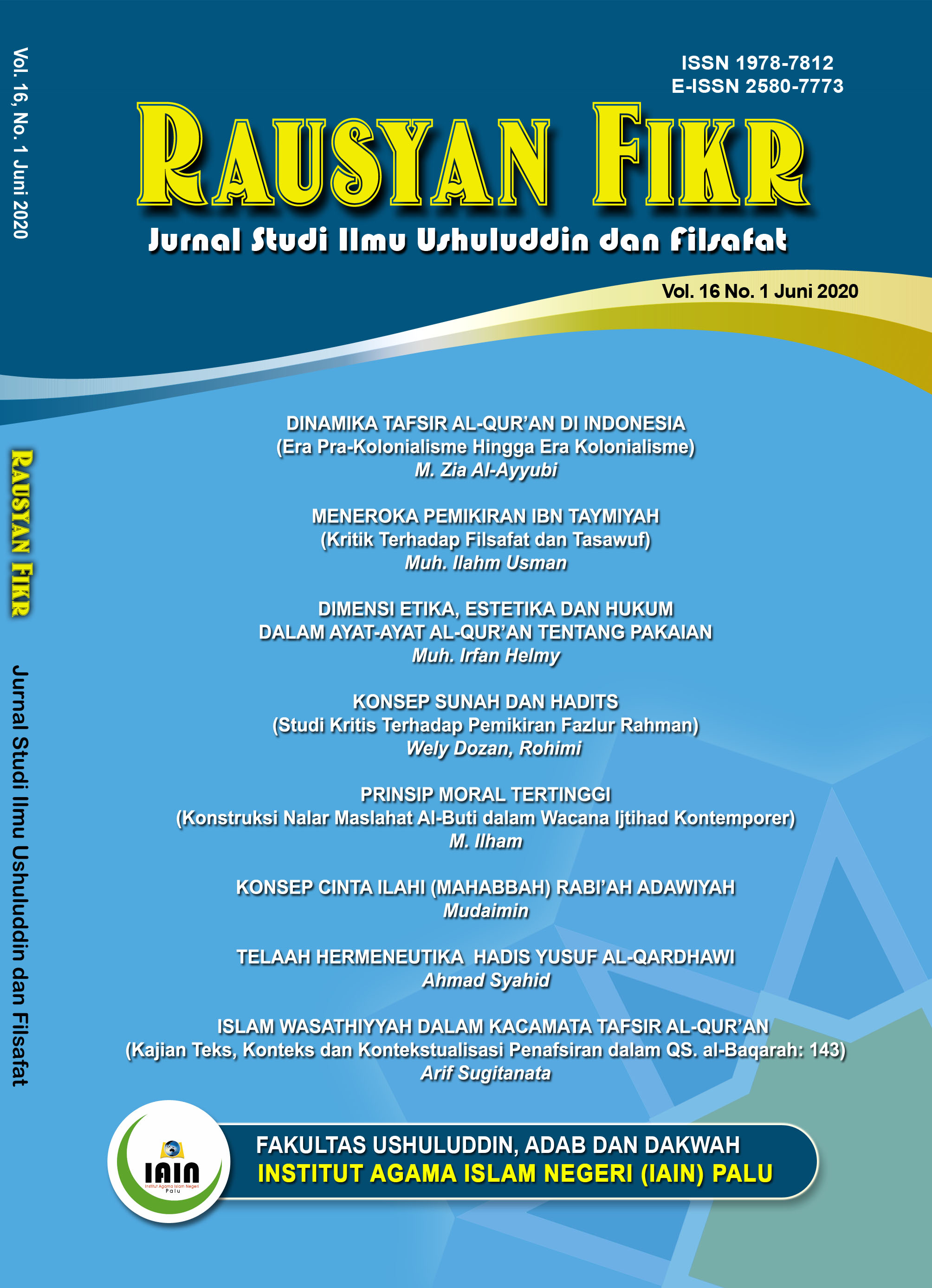
KONSEP SUNAH DAN HADITS
(Studi Kritis Terhadap Pemikiran Fazlur Rahman)
Abstract
Studies of the Sunnah and Hadith to date have never ceased to be discussed even in criticism. Historically the Sunnah and hadith originated from the original Prophet Muhammad. However, this is not the same in an Orientalist perspective where the concept of sunnah and hadith is actually positioned as the work of Arabic Ulama which is usually developed by generations of friends and tabi'in. The questions that lie behind Fazlur Rahman give their approval through various originalist debates which Rahman considers to have understood the true concept of the Sunna and Hadith. The results of Fazlur Rahman thoughts show that, basically the Sunna and hadith remain from the Prophet Muhammad. Thus, this paper is here to provide concepts related to fazlur Rahman how the concepts and their validity of Islamic modernity of hadits.
Kajian terhadap Sunnah dan Hadits sampai saat ini tidak pernah berhenti untuk diperbincangkan bahkan sampai di kritik mulai dari keserjanaan barat yakni kalangan orientalis yang tidak begitu percaya terhadap keotentikan sebuah hadits. Secara historis sunah dan hadis asli bersumber dari Nabi Muhammad Saw. Namun, hal ini tidak senada dalam perspektif orientalis yang dimana konsep sunah dan hadis sebenarnya diposisikan sebagai hasil karya-karya ulama Arab yang biasanya dikemabangkan oleh generasi sahabat dan tabi’in. Berangkat dari asumsi-asumsi ini yang melatar belakangi fazlurrahman memberikan kontribusi melalui berbagai pergejolakan diantara beberapa pemikiran orentalis yang dimana rahman menganggapnya telah salah memahami konsep sunah dan hadis yang sebenarnya. Hasil dari pemikiran Fazlurrahman menunjukkan bahwa, pada dasarnya sunah dan hadis tetap berasal dari Nabi Muhammad Saw yang bersifat otentik dalam hukum Islam. Dengan demikian, tulisan ini hadir untuk memberikan konsep yang baru terkait pemikiran fazlurrahman melaui konsep modernitas Islam terhadap hadits.
References
Dozan, Wely Kritik Hadits Joseph Schacht: Studi Analisis Teori Projecting Back, Jurnal: Sophist, Vol. 1,No.1, Juni, 2018.
Kholis Setiawan, Nur. Syamsuddin, Sahiron Orientalisme Al-Qur’an dan Hadis, Nawesea Press: Center for the Study of Islam in North America, Western Europe and Southeast Asia Prres, 2001.
Chamami, Rizka Studi Islam Kontemporer, Semarang: Pustaka Rizki Putra, 2012.
Kasman, Hadist dalam pandangan muhammadiyah, Yogyakarta: Mitra Pustaka, 2012.
Dozan, Wely Hermeneutika Sebagai Metode Penafsiran Al-Qur’an (Melacak Teori Fazlurrahman), (Jurnal: El-Hikam, Volume XII, Nomor 1, Januari –Juni 2019.
Syamsuddin, Sahiron Hermeneutika Al-Qur’an dan Hadits, Yogyakarta: Elsaq Prres, 2010.
Ma’mun Mu’min, Hadis dan sunah dalam perspektif Fazlur Rahman, Jurnal: Riwayat, Vol. 1, No. 2, September 2015.
Ulya, Hermeneutika double movement Fazlur Rahman menuju penetapan hokum bervisi etis, Jurnal. Jurusan ushuludin STAIN Kudus.
Rahman, Fazlur Islam, ter. Sinoaji Saleh, Jakarta: Bina Askara, 1987.
Taufik Adnan Amal, Islam Tantangan Modernitas (Studi Atas Pemikiran Hukum Fazlurrahman), (Bandung: Mizan Anggota IKAPI,1998), hlm.163
Farida, Umma Studi pemikiran fazlur rahman tentang sunnah dan hadis, Jurnal, ADDIN, Vol. 7 No. 2 Agustus 2013 Hal 228 (Diakses tanggal 1 Januari 2019 .
Umma Farida, Kontribusi Pemikiran Muhammad Mustofa Al-Azami Dalam Studi Hadits, Yogyakarta: Pustaka Pelajar, 2018.
Suryadilaga, Alfatih Ulumul Hadits, Yogyakarta: Teras , 2010.
Muhammad ‘Ajaj Al-khatib, Ushul Al-Hadits, pokok-pokok ilmu hadits, Jakarta: Gaya Media Pratama, 2013.
Sahid HM, Sejarah evolusi sunnah study pemikiran fazlur rahman, jurnal. Al-Tahrir, Vol. 11, No. 1 Mei 2011.
Fazlurrahman, Islam dan Modernitas Tentang Transformasi Intlektual, Bandung: PUSTAKA, 2005.
Abdul Fatah Idris, Hadis-hadis prediktif dan teknis studi pemikiran Fazlur Rahman, Semarang: Pustaka Rizki Putra, 2012.
Muhammad Alawi Al-Maliki, Ilmu Ushul Hadits, Yogyakarta: Pustaka Pelajar, 2006.
Copyright
The author(s) retain full copyright of the published article without restrictions. This includes the right to share, distribute, and reproduce the article in any form, including depositing the published version in institutional repositories or other platforms.
The author(s) also retain full publishing rights and may enter into separate, additional contractual arrangements for the non-exclusive distribution of the journal’s published version, provided that the original publication in this journal is properly acknowledged.
The author(s) grant the journal the right of first publication, as well as the right to distribute the article in both electronic and print formats. The journal is also granted the right to create, store, and maintain electronic archival copies of the article.
License to Publish

Rausyan Fikr: Jurnal Ilmu Studi Ushuluddin dan Filsafat is an open-access journal and under the licence of Creative Commons Attribution–NonCommercial–Share Alike 4.0 (CC–BY–NC–SA), which allows journal users to use the article under the following conditions.
Under this license, users are permitted to:
- Share — copy and redistribute the material in any medium or format.
- Adapt — remix, transform, and build upon the material.
Under the following terms:
- Attribution — Appropriate credit must be given to the author(s) and the original source, a link to the license must be provided, and any changes made must be indicated. This must be done in a reasonable manner without suggesting endorsement by the author(s) or the journal.
- NonCommercial — The material may not be used for commercial purposes.
- ShareAlike — If the material is remixed, transformed, or built upon, the resulting work must be distributed under the same license as the original.
No additional restrictions may be applied that would legally limit others from doing anything the license permits.



_(1)1.png)

















 This work is licensed under a