
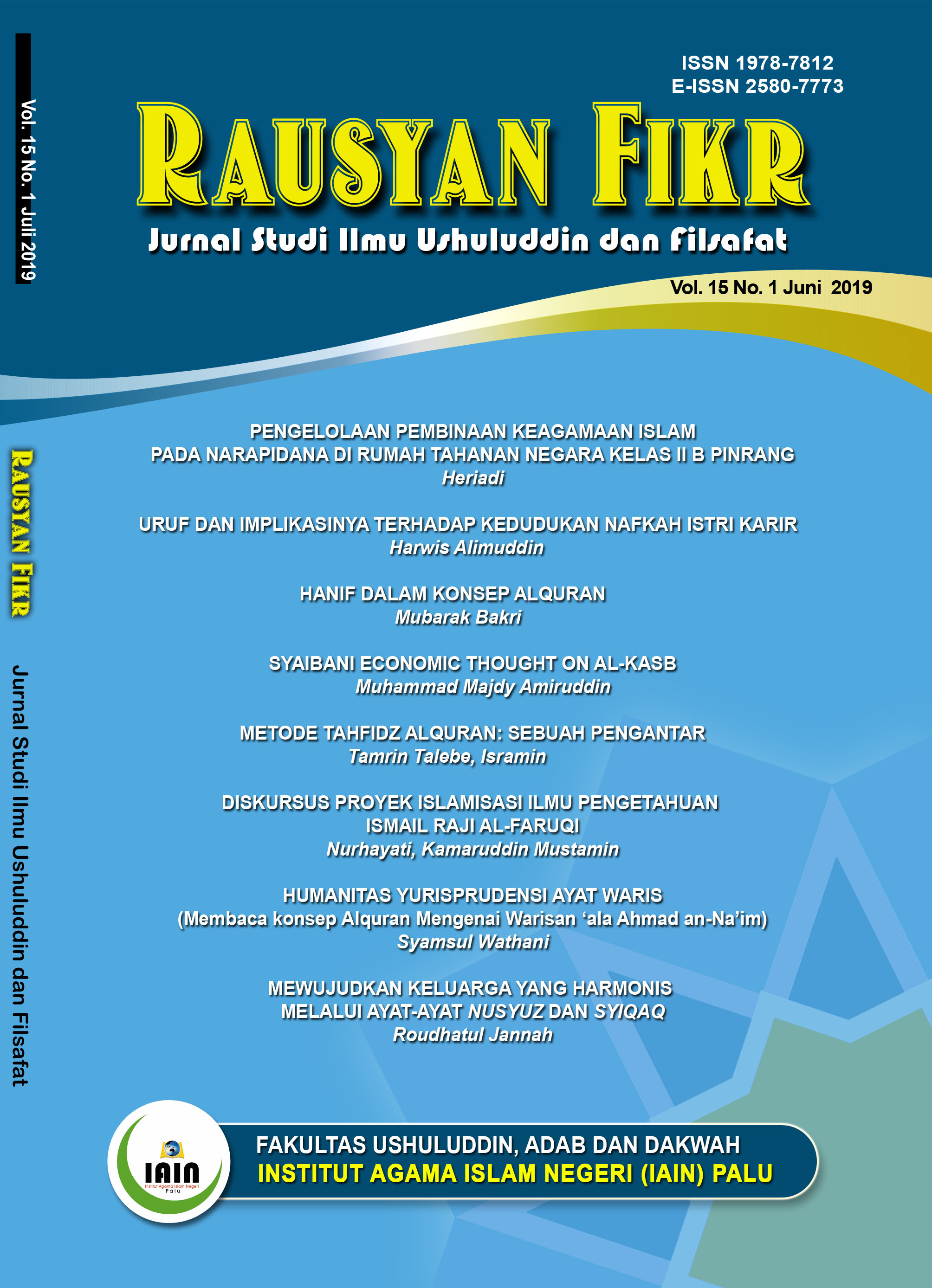
METODE TAHFIDZ ALQURAN : SEBUAH PENGANTAR
Abstract
Tahfidz Alquran or memorization of the Koran is the oldest tradition in efforts to preserve the Koran. Along with the history of Islam development, various efforts were made to preserve the tradition. The goal of become a hafidz is to achieve the salvation of his religion through the preservation of the scriptures. Various methods applied as an effort to memorize the Koran. Various methods to memorize Koran including Talqin method and Tikrar method, listening to recordings, movements and gesture methods, method of reading verses to be memorized, memorization method by recording the voice of teachers and children, method of listening to recordings of reading verses of the Qur'an from the teacher and their peers, the Sima'i / Tasmi method, the Muraja'ah method, the Jama' method or the Kitabah method.
Copyright
The author(s) retain full copyright of the published article without restrictions. This includes the right to share, distribute, and reproduce the article in any form, including depositing the published version in institutional repositories or other platforms.
The author(s) also retain full publishing rights and may enter into separate, additional contractual arrangements for the non-exclusive distribution of the journal’s published version, provided that the original publication in this journal is properly acknowledged.
The author(s) grant the journal the right of first publication, as well as the right to distribute the article in both electronic and print formats. The journal is also granted the right to create, store, and maintain electronic archival copies of the article.
License to Publish

Rausyan Fikr: Jurnal Ilmu Studi Ushuluddin dan Filsafat is an open-access journal and under the licence of Creative Commons Attribution–NonCommercial–Share Alike 4.0 (CC–BY–NC–SA), which allows journal users to use the article under the following conditions.
Under this license, users are permitted to:
- Share — copy and redistribute the material in any medium or format.
- Adapt — remix, transform, and build upon the material.
Under the following terms:
- Attribution — Appropriate credit must be given to the author(s) and the original source, a link to the license must be provided, and any changes made must be indicated. This must be done in a reasonable manner without suggesting endorsement by the author(s) or the journal.
- NonCommercial — The material may not be used for commercial purposes.
- ShareAlike — If the material is remixed, transformed, or built upon, the resulting work must be distributed under the same license as the original.
No additional restrictions may be applied that would legally limit others from doing anything the license permits.


_(1)1.png)
















 This work is licensed under a