
PRASANGKA DALAM AL-QUR’AN
Abstract
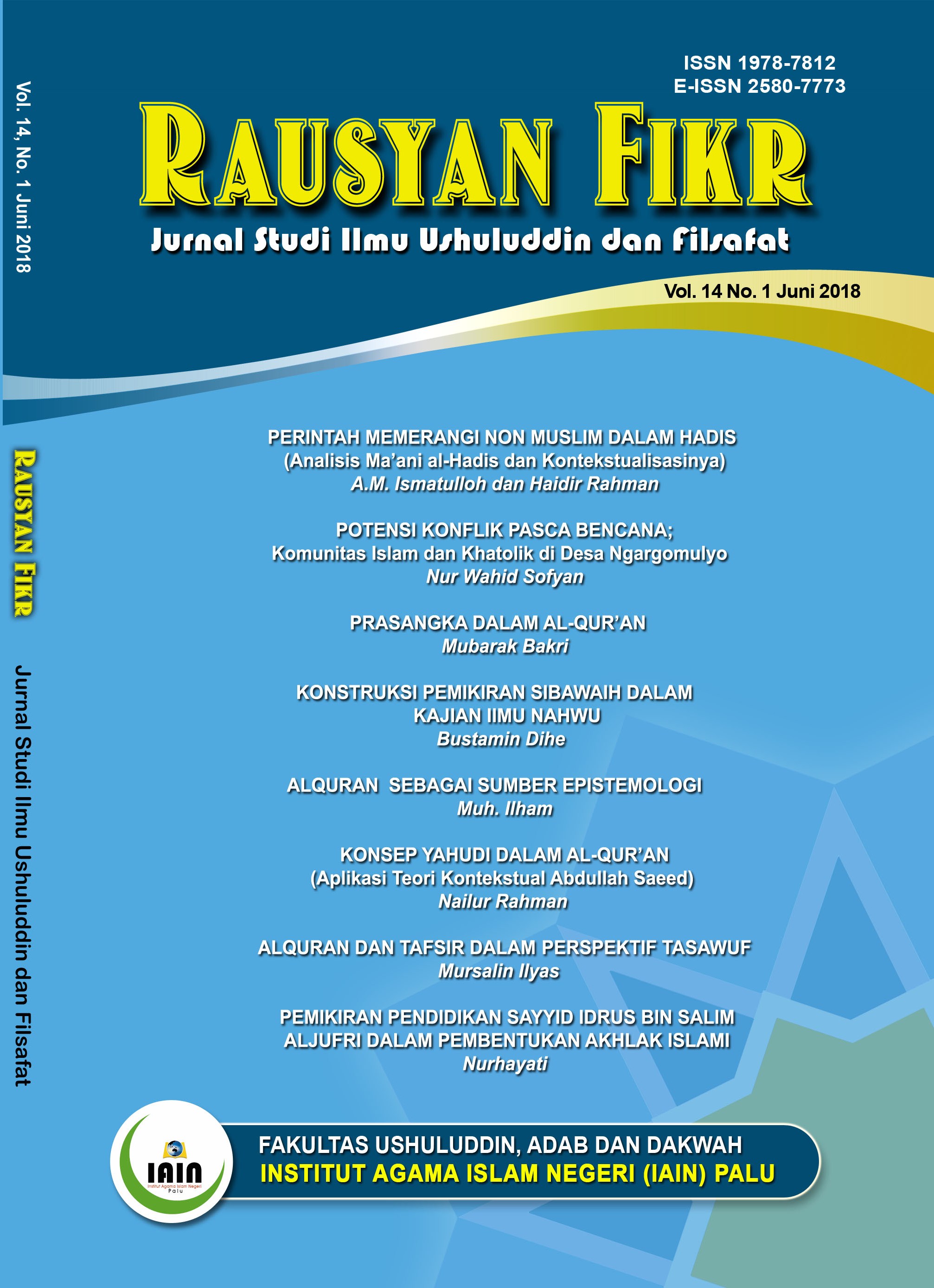
Prejudice is one of the causes of horizontal conflict in the society today. Starting from prejudice giving rise to excessive suspicion which led to slander and disharmony between one another. Through this article, the author discusses prejudice in the Koran as a source of solutions to all diseases, including prejudice as a social disease. The author uses thematic interpretations as a method in constructing the Qur'anic insights related to verses examining prejudice by taking the keyword az-zannu. Through this word, it is elaborated in depth the nature of az-zannu and its characteristics in the Qur'an, and how it relates to the az-zannu with its own prejudices. Finally, the author also describes the influence of prejudice in modern society today.
References
Alquran Al-KarimMusta>fa Muslim, Maba>hi>s fi Tafsir al-Maudui>’(Mesir: Da>r al-Ilm, 1989 M/ 1310 H.)Al-Nawawi al-Damsyq al-Imam Abi Zakariya Yahya, Syarh Shahih Muslim, Ta>hqi>q Ha>ni al-Haj dan ‘Imad Zaki al-Baru>di>,al-Maktabah at-Taufiqiyah,676 H, Juz 15-16Baumerster Roy F dan Bushman Brad J, Social Psychology Human Nature (Jakarta: Bulan Bintang:2008),Abūal-Ḥusain Aḥmad Ibn Fāris, Mu’jam Maqāyis al-Lugah, juz 3 (Beirut: Dār al-Fikr, 1399 H/1979)Ismail bin Himad, al-Shiha>hu fi al-‘Arabiyah,(Cet I;Beirut:Da>r al-Ma>rifah, 1426 H/2005 M)
Muhammad Patri Arifin, “Penafsiran Kontekstual Kesaksian Perempuan”, Musawa: Jurnal For Gender Studies, Vol. 9 No. 1, 2017. Al-Ghazali,Abu Hamid Muhammad bin Muhammad, Ihya ’Ulum al-Din, Juz III (t.t:Matbah al-H}albiy:1358 H/1939 M)Al-Ansa>ri, Abu Yahya Zakariya bin Muhammad, al-Hudu>d al-Ani>qatu wa al-Ta’rifa>t al-Daqiqatu,(Cet I; Beirut: Da>r al-Fikr al-Mu’a>sar, 1411 H)Syauqi Dhaif, Al-Mu'jam Al-Wasith, (Mesir: Maktabah Shurouq ad-Dauliyyah, 2011)Mahmud 'Abdurrahman 'Abdul Mun'im, Mu'jam al-Mushtalahat wa al-Fadz al-Fiqhiyyah, (al-Qahirah: Dar al-Fadhilah:t.th)As-Sayyid Asy-Sya>rif Abil Hasan ‘Ali Bin Muhammad bin ‘Ali al-Husaini al-Jurjani, Al-Ta’rifa>t (Cet. III; Beirut: Darul Kutub Ilmiyyah,2009)53Al-Amradh al Khafiyyah wal Aatsar al Jaliyyah,‛ Yahya Bin Musa al-Zahrani, Riyadh: Dar ash-Shami'i: 2011,h. 87.
Niẓām al-Dīn al-Ḥasan Ibn Muḥammad Ibn Ḥusain al-Qummīal-Naisābūrī, Garā’ib al-Qur’ān wa Ragā’ib al-Furqān, juz 1 (Cet. I; Beirut: Dār al-Kutub al-‘Ilmiyah, 1416 H)‘Abd al-Karīm al-Khaṭīb, al-Tafsīr al-Qur’ānīli al-Qur’ān, juz 10 (Kairo: Dār al-Fikr al-‘Arabī, t.th.)Muḥammad Mutawwalīal-Sya’rāwī, Tafsīal-Sya’rāwī,juz 10 (Kairo: Muṭābi’Akhbār al-Yaum, t.th.)Muḥammad Sayyid Ṭanṭāwī, Tafsīr al-Wasīṭli al-Qur’ān al-Karīm, juz 4 (Cet. I; Kairo: Dār al-Nahdah, 1997 )Jābir al-Jazā’arī, Aisar al-Tafāsīr li Kalām al-‘Alīal-Kabīr, juz 5 (Cet. I; Madinah: Maktabah al-‘Ulūm wa al-Ḥikam, 1424 H)Nāṣir al-Dīn al-Bānīdalam kitabnya al-ḤadīṡḤujjah bi Nafsih fīal-‘Aqā’id wa al-Aḥkam (Cet. I; Maktabah al-Ma’ārif, 1425 H)‘Abdu Baqi, Muhammad fuad, al-Mu’jam al-Mufahras li Al-Fa>z}I Alquranal-Karim (Cet I; Cairo:al-Da>r al-Hadis, 1417 H/1996 M)Al-Qurtubi, Abu ‘Abdullahbin Ahmad bin Abu Bakar, al-Ja>mi’ li Ahka>m al-Qur’an, Juz 10 (Cet I; Beirut: Da>r Ihya al-Turats> al-‘Arabi, 1416 H/1995 M), h. 254. Lihat juga Al-Syauka>ni, Muhammad bin ‘Ali bin Muhammad, Fath l-Qadi>r, Juz 5 (Cet I; t.t:Da>r al-Wafa>, 1415 H/1994 M)Al-Thabari, Abu Ja’far Muhammad Jari>r, Ja>mi’ al-Baya>n ‘an Ta’wil ay al-Qur’an, Tahqiq: Ahmad Muhammad Sya>kir , Juz I (Cet I; Ordon: Da>r al-A’lam, 2002 M), h. 244-245. Lihat juga Al-Qurtubi, Al-Baghawi>, Abu Muhammad al-Husain bin Mas’ud, Mua>’lim al-Tanzi>l, Pentahqiq Muhammad ‘Abdullah al-namar, Us>man Jum’at Dami>riyah, Sulaiman Muslim al-Harsy, Juz I (Cet 4;t.t:Da> Tayyibah li Nasyri wa al-Tauzi>’, 1417 H/1997 M
Copyright
The author(s) retain full copyright of the published article without restrictions. This includes the right to share, distribute, and reproduce the article in any form, including depositing the published version in institutional repositories or other platforms.
The author(s) also retain full publishing rights and may enter into separate, additional contractual arrangements for the non-exclusive distribution of the journal’s published version, provided that the original publication in this journal is properly acknowledged.
The author(s) grant the journal the right of first publication, as well as the right to distribute the article in both electronic and print formats. The journal is also granted the right to create, store, and maintain electronic archival copies of the article.
License to Publish

Rausyan Fikr: Jurnal Ilmu Studi Ushuluddin dan Filsafat is an open-access journal and under the licence of Creative Commons Attribution–NonCommercial–Share Alike 4.0 (CC–BY–NC–SA), which allows journal users to use the article under the following conditions.
Under this license, users are permitted to:
- Share — copy and redistribute the material in any medium or format.
- Adapt — remix, transform, and build upon the material.
Under the following terms:
- Attribution — Appropriate credit must be given to the author(s) and the original source, a link to the license must be provided, and any changes made must be indicated. This must be done in a reasonable manner without suggesting endorsement by the author(s) or the journal.
- NonCommercial — The material may not be used for commercial purposes.
- ShareAlike — If the material is remixed, transformed, or built upon, the resulting work must be distributed under the same license as the original.
No additional restrictions may be applied that would legally limit others from doing anything the license permits.



_(1)1.png)
















 This work is licensed under a