
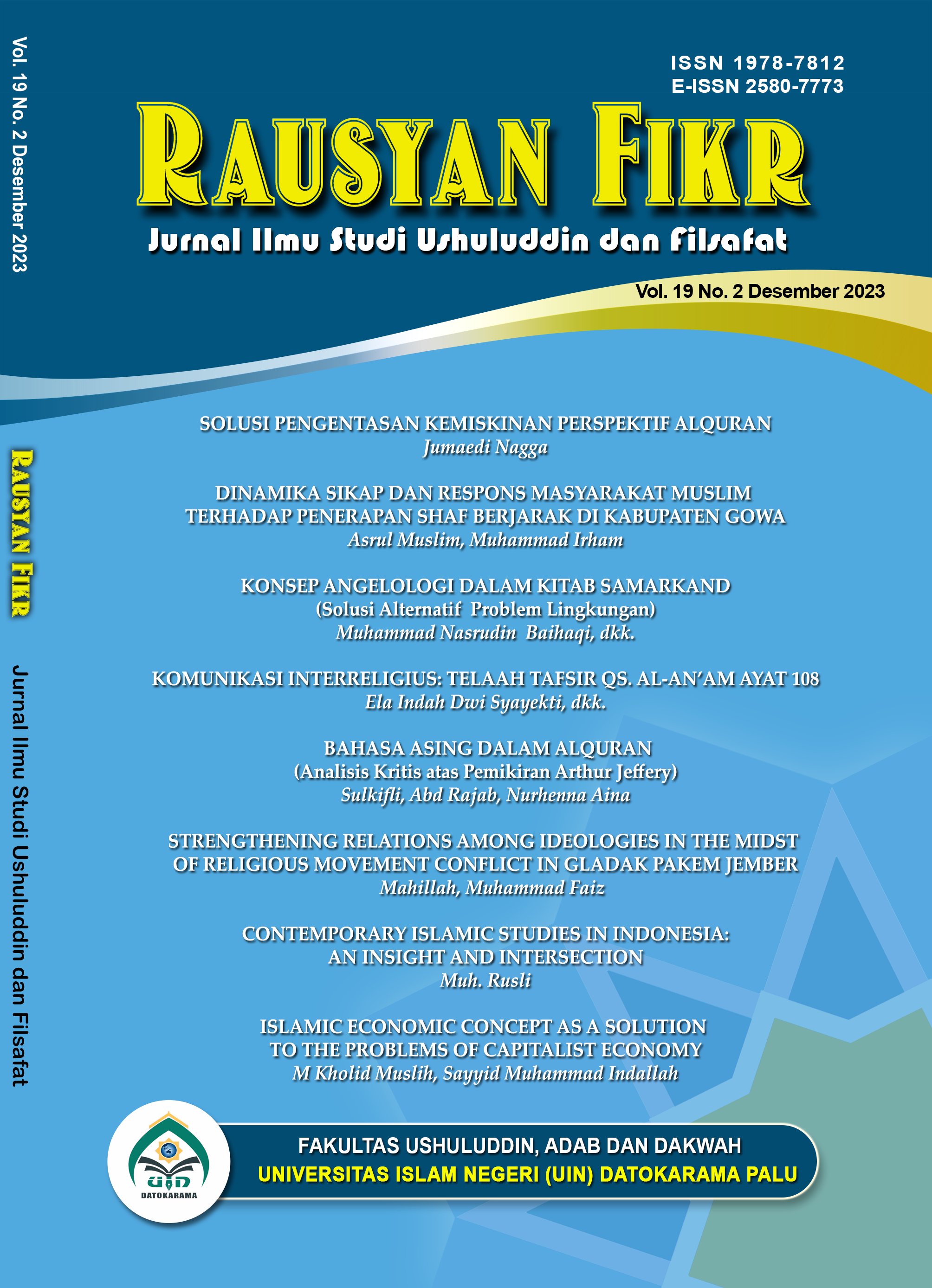
BAHASA ASING DALAM ALQURAN
(Analisis Kritis atas Pemikiran Arthur Jeffery)
Abstract
The objective of this article is to examine and analyze Arthur Jeffery's thoughts on the Qoran. This research is qualitative research with a literature review. Arthur with his philological method, analyzes the foreign languages (non-Arabic) contained in the Quran, at least he found around 316-317 foreign languages adopted by the Prophet in the Quran, as stated in his book entitled “The Foreign Vocabulary of The Quran”. Various accusations directed by Arthur to discredit and weaken the religion of Islam have raised doubts about this divine revelation. The results of this study indicate that the accusations made by Arthur about the existence of foreign words and the Prophet Muhammad who has been influenced by previous religions, such as Judaism and Christianity mostly use prejudice and mere assumptions and do not present scientific analysis data with evidence of historical studies and data as reinforcement for his argument.
References
Agustiar. “Orientalis dan Peranannya dalam Mempelajari Bahasa Arab,” Jurnal Ushuluddin, Vol. 17, No. 2, (2011): 145-158. https://ejournal.uin-suska.ac.id/index.php/ushuludin/article/view/688
Ali, Hafiz Sfarish, and Muhammad Sultan Shah. “An Exposition of Arthur Jeffery as a Methodist Missionary Orientalis,” Al-Misbah: Research Journal, Vol. 3, No. 1, (2023): 32-47. https://reinci.com/ojs3308/index.php/almisbah/article/view/81
Anshori, Muhammad. “Tema-Tema Kajian Al-Qur’an di Barat Perspektif Fazlur Rahman (1919-1988).” QOF: Jurnal Studi Al-Qur’an dan Tafsir, Vol. 4, No. 2, (2020): 247-266. https://jurnalfuda.iainkediri.ac.id/index.php/qof/article/view/231
Ash-Shiddieqi, Hasbi. Sejarah dan Pengantar Ilmu Al-Qur’an dan Tafsir. Cet. V; Semarang: PT. Pustaka Rizki Putra, 2012.
Badeau, Jhon S. Arthur Jeffery a – Tribute (The Muslim World, Volume 50, 1960), https://www.answering-Islam.org/Books/Jeffery/tribute.htm
Baidan, Nasharuddin. Metode Penafsiran al-Qur’an, “Kajian kritis terhadap ayat-ayat yang beredaksi mirip”, Cet. I; Yogyakarta: Pustaka Pelajar, 2002.
Chirzin, Muhammad. Fenomena Al-Qur’an. Cet. I; Yogyakarta: Pustaka Pelajar, 2018.
Fahrizi, Nur, dan Muhammad Zubir. “Historitas dan Otentisitas Al-Qur’an (Studi Komparatif antara Arthut Jeffery dengan Manna’ Al-Qathan),” QiST: Journal of Qur’an and Tafseer Studies, Vol. 1, No. 2, (2022): 79-117. https://pdfs.semanticscholar.org/9e97/7910ec209f7e69d0e561e2ec624b2f9e51a5.pdf
Faiz, Fahruddin. Hermeneutika Al-Qur’an: Tema-Tema Kontroversial. Cet. I; Yogyakarta: Kalimedia, 2015.
Hammam, “Analisis Kata Serapan Bahasa Asing dalam Al-Quran Perspektif Imam Suyuthi,” Prosiding Konferensi Nasional Bahasa Arab V, Malang, 5 Oktober 2019.
Hikmah, Ismi Wakhidatul, dan Lianfin Safira Aulia. “Analisis Wacana Kritis Adopsi Bahasa Asing dalam Al-Qur’an dalam Buku Arthur Jeffery (The Foreign Vocabulary of the Quran).” JALSAH: The Journal of al-Quran and as-Sunnah Studies, Vol. 2, No. 1, (2022): 47-53. https://jurnalannur.ac.id/index.php/jalsah/article/view/228
Holilurrahman, Dkk, Ilmu al-Qur’an dan Tafsir (cet. 1; Bandung; Arfino Raya, 2013)
Jeffery, Arthur. The Foreign Vocabulary of The Quran. Amerika: Georgias Press, 2009.
Khoir, Nirmala, dan Fitriah, “Eksistensi Lafaz-Lafaz Al-Muarrab dalam Pembelajaran Al-Qur’an.” Al-Iltizam: Jurnal Pendidikan Agama Islam, Vol. 6, No. 2, (Desember 2021): 91-106. https://jurnal.iainambon.ac.id/index.php/ALT/article/view/2463
Laili, Iffa Nur. “Kosakata Asing dalam Al-Qur’an (Kajian Kritis terhadap Kosakata Mesir Kuno dalam Perspektif Sa’ad Abd al-Mutalib al-Adl).” Tesis. Jakarta: UIN Syarif Hidayatullah, 2014.
Mardan. Al-Qur’an Sebuah Pengantar Memahaminya Secara Utuh. Cet. II; Jakarta: Pustaka Mapan, 2010.
M. Muzayyin. “Al-Qur’an Menurut Pandangan Orientalis (Studi Analisis “Teori Pengaruh” dalam Pemikiran Orientalis),” Jurnal Stusi Ilmu-Ilmu Al-Qur’an dan Hadis, Vol. 16, No. 2, Juli (2015): 203-221. https://www.neliti.com/publications/271066/al-quran-menurut-pandangan-orientalis-studi-analisis-teori-pengaruh-dalam-pemiki
_______. “Pendekatan Historis Kritis dalam Studi al-Qur’an (Studi Komparatif Terhadap Pemikiran Theodore Noldeke dan Arthur Jeffery). Tesis. Yogyakarta: UIN Sunan Kalijaga, 2015.
al-Qaththan, Manna’. Mabahits fi Ulumil Qur’an, penerjemah: Umar Mujtahid, Dasar-Dasar Ilmu Al-Qur’an. Cet. I; Jakarta: Ummul Qura, 2017.
Qur’an Kemenag. https://quran.kemenag.go.id
Rihlasyita, Wilda. “Telaah Pendekatan Linguistik dalam Buku Metodologi Bibel dalam Studi al-Qur’an‘ (Sebuah Kajian Kritis).” Al-Yasini: Jurnal Keislaman, Sosial, Hukum dan Pendidikan, Vol. 3, No. 2, (November 2018): 133-146. https://garuda.kemdikbud.go.id/journal/view/16820
Ritonga, Mahyuddin. “Pandangan para ahli bahasa tentang bahasa serapan dalam al-Qur’an.” Afkaruna: Jurnal Ilmu-Ilmu KeIslaman, Vol. 11, No. 1, (2015): 1-28. https://journal.umy.ac.id/index.php/afkaruna/article/view/2201
_______. “Bargaining Kata di dalam Al-Qur’an: Kontroversi Ahli Terhadap Bahasa Al-Qur’an.” AKADEMIKA: Jurnal Pemikiran Islam, Vol. 21, No. 02, (2016): 229-254. https://e-journal.metrouniv.ac.id/index.php/akademika/article/view/466
Safri, Arif Nuh. “Analisis Kritis atas Ahistoritas Pemikiran Arthur Jeffery.” Al-‘Adalah, Vol. 17, No. 1 (Mei 2014): 135-162. https://adoc.pub/analisis-kritis-atas-ahistorisitas-pemikiran-arthur-jeffery.html
al-Suyuthi, Imam Jalaluddin. al-Itqan fi ‘Ulumil Qur’an. Penerjemah. Muhammad Halabi, Samudra Ilmu-Ilmu Al-Qur’an. Jil. 2; Cet. I; Yogyakarta: DIVA Press, 2021.
Shihab, M. Quraish. Kaidah Tafsir: Syarat, Ketentuan, dan Aturan yang Patut Anda Ketahui dalam Memahami Ayat-Ayat al-Qur’an. Cet. III; Tangerang: Lentera Hati, 2015.
Shihab, M. Quraish. Membumikan Al-Qur’an: Fungsi dan Peran Wahyu Dalam Kehidupan Masyarakat. Cet. III; Bandung: Mizan, 2009.
Ubaidillah, Ismail. “Kata Serapan Bahasa Asing dalam Al-Qur’an dalam Pemikiran At-Thobari.” At-Ta’dib: Journal of Pesantren Education, Vol. 8, No. 1 (2013): 119-132. https://ejournal.unida.gontor.ac.id/index.php/tadib/article/view/517
Wijaya, Aksin. Arah Baru Studi Ulum Al-Qur’an, (Memburu Pesan Tuhan di Balik Fenomena Budaya). Cet. I; Yogyakarta: Pustaka Pelajar, 2009.
Zainab, Cut. “Bantahan terhadap Argumentasi Orientalis, Textual Criticism of The Quran, (Studi Kritis tentang Tuduhan Kesalahan Penyalinan).” Tesis. Banda Aceh: UIN Ar-Raniry, 2022.
Copyright
The author(s) retain full copyright of the published article without restrictions. This includes the right to share, distribute, and reproduce the article in any form, including depositing the published version in institutional repositories or other platforms.
The author(s) also retain full publishing rights and may enter into separate, additional contractual arrangements for the non-exclusive distribution of the journal’s published version, provided that the original publication in this journal is properly acknowledged.
The author(s) grant the journal the right of first publication, as well as the right to distribute the article in both electronic and print formats. The journal is also granted the right to create, store, and maintain electronic archival copies of the article.
License to Publish

Rausyan Fikr: Jurnal Ilmu Studi Ushuluddin dan Filsafat is an open-access journal and under the licence of Creative Commons Attribution–NonCommercial–Share Alike 4.0 (CC–BY–NC–SA), which allows journal users to use the article under the following conditions.
Under this license, users are permitted to:
- Share — copy and redistribute the material in any medium or format.
- Adapt — remix, transform, and build upon the material.
Under the following terms:
- Attribution — Appropriate credit must be given to the author(s) and the original source, a link to the license must be provided, and any changes made must be indicated. This must be done in a reasonable manner without suggesting endorsement by the author(s) or the journal.
- NonCommercial — The material may not be used for commercial purposes.
- ShareAlike — If the material is remixed, transformed, or built upon, the resulting work must be distributed under the same license as the original.
No additional restrictions may be applied that would legally limit others from doing anything the license permits.


_(1)1.png)
















 This work is licensed under a